

The Brain Interaction Network (BINe) team hosted the February Stanley Center Social and introduced its people to the Stanley Center community.
Taibo Li awarded full MD/PhD scholarship from Johns Hopkins School of Medicine
Taibo has recently been awarded a full MD/PhD scholarship to Johns Hopkins School of Medicine. Taibo started in the Lage Lab in April 2013 and worked on several projects including InWeb, GeNets, BINe, CanComSq. He looks forward to continuing working with the Lage Lab from his new position at Hopkins and we wish him the best of luck!

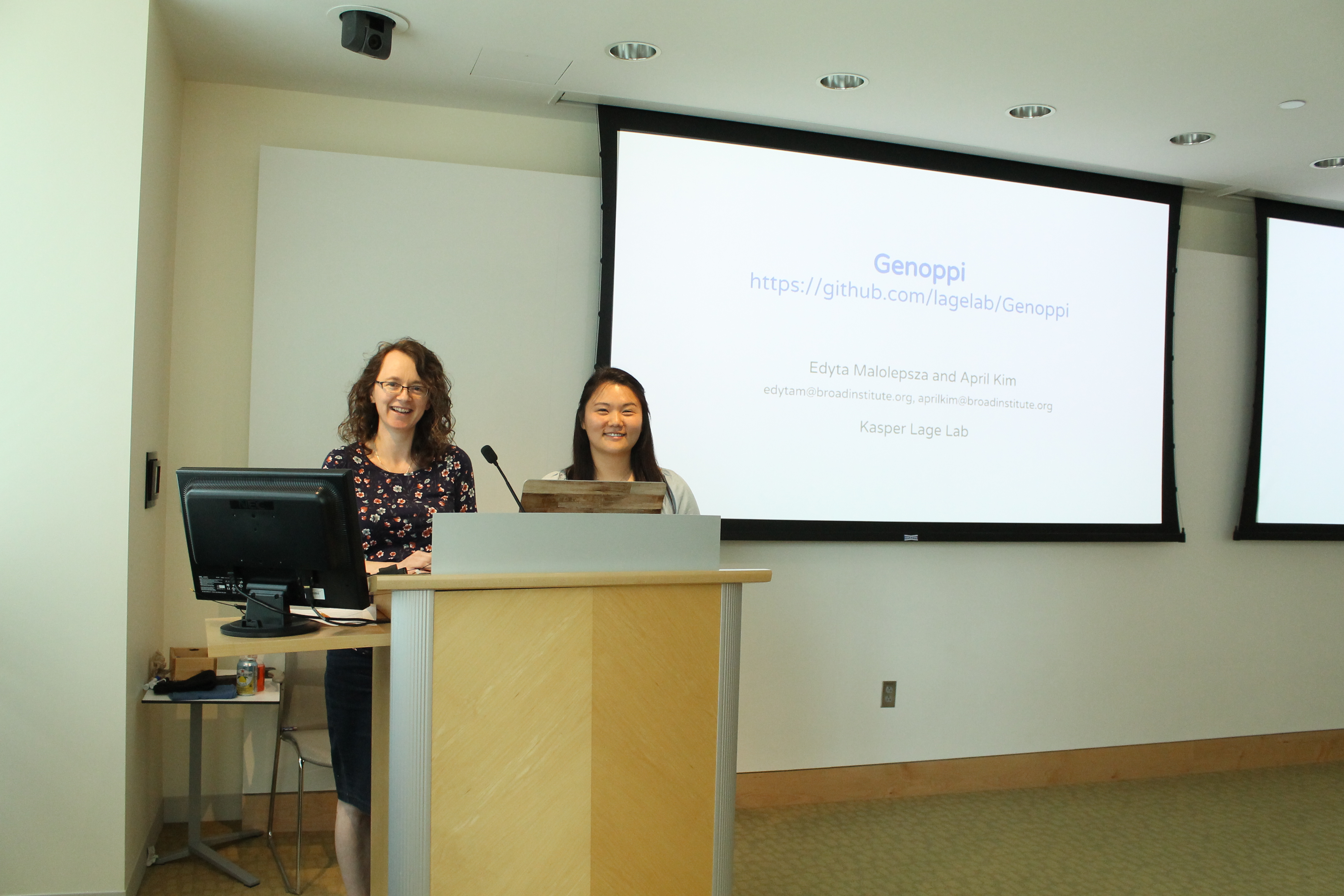
April Kim and Edyta Malolepsza host BroadE workshop on web platform Genoppi that integrates experimental proteomics and genetic data
April and Edyta hosted a BroadE (E for Education) workshop on their newest web platform, Genoppi, which integrates experimental proteomics and genetic data. The workshop was oversubscribed and will likely be repeated at a later time to accommodate many people who couldn’t get a spot.

April Kim presents GeNets at Boot Camp for new postdocs joining the Broad Institute’s Cancer Program
Kasper and April were invited by Brett Tomson to present GeNets as part of the network tools lecture to the postdocs attending Cancer Program BootCamp.
April Kim and Edyta Malolepsza presents CanComSq and showcase Genoppi at Boot Camp for new postdocs joining the Broad Institute’s Cancer Program
Jakob Jespersen presented his work at the Center for Mendelian Genetics at the Broad Institute

Jakob Jespersen, member of Lage Lab at MGH and the Broad Institute, presented at the Center for Mendelian Genetics Analysis meeting the Interpretation of missense variants using protein structures and features. Jakob explained that with a vast amount of exome sequencing data, it is difficult to identify the missense variants that may be implicated in diseases. While it is possible to crudely classify variants as “loss of function” based on observations such as the mutation being in a splice site, creating a stop codon or frameshift, it is much more difficult to determine whether missense mutations are deleterious or benign.
Since the Protein Data Bank (PDB) hosts information on more than 6,000 different human proteins, it is possible to add structural information to help the classification of missense mutations. Some methods are already utilizing features from 3D protein structures, so the presentation was focused on features that we can extract and calculate which are not in use yet as well as a computational tool set Jakob has developed for this purpose.
Enjoy the recording of the Jakob’s presentation in the video below (Sep 20th, 2016)
Taibo Li gave an invited poster presentation at the Fourth Annual Broad Institute – Israel Science Foundation Cell Circuits Symposium
The title of his poster ‘Human brain networks perturbed by genetics and targeted by therapeutics in psychiatric disorders’
Joy Poulo Presented his work at a Simches Seminar at MGH
Title of Joy’s talk: “Congenital Diaphragmatic Hernia: Exome sequence analysis of trios”
Joy Poulo presented his work at Harvard Medical School
Title of Joy’s poster: “Transcriptome assisted prioritization of congenital diaphragmatic hernia genes”
April Kim presented her work at Harvard Medical School
The title of Aprils poster: “Brain Interaction Network Project: Mapping of single-gene schizophrenia loci to define index proteins and isoforms expressed in Ngn2 neurons for proteomics experiments”